Read a DISC profile as a pattern
A DISC profile shows a pattern across D, I, S and C. This site’s percentages are relative within one report, not ranks among other people.
What you need to know
A DISC profile shows a pattern across D, I, S and C. This site’s percentages are relative within one report, not ranks among other people.
Meaning and how it works
Look at the full distribution, close scores and the setting used when answering. Naming the highest dimension can be convenient, but a small difference does not establish a distinct type. A second preference may be just as useful to discuss.
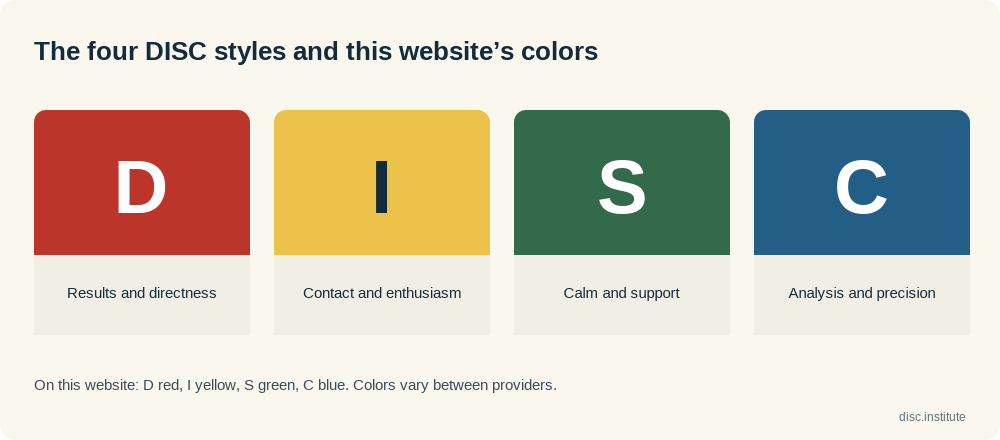
An explanatory diagram of four DISC styles. The panels show behavioral emphases, not a test result, fixed types of people or a scientifically determined color system.
How to apply this in practice
Choose a recent situation and test the description against your actions. Note what fits, what does not and what circumstances might explain the difference. Turn one useful observation into a behaviour you can practise.
- 1
Read all four dimensions together.
- 2
Find supporting and contradictory examples.
- 3
Choose one practical experiment and review it.
Turn a profile into a question to investigate
Make two columns: fits and does not fit. In each, describe a concrete event with the task, circumstances and your action. A statement such as I am red is too vague for this exercise.
Choose one question for the next situation: do I ask for clarification before deciding? Record what you did and the response. Evaluate that action rather than whether you chose the right colour.
Read a result in three layers
Start with the numbers: which values are close together? Next, consider recognition: which concrete situation supports the description and which contradicts it? Finally, choose a behavioural question for your next situation.
A score without a reference group
Our percentages compare the four dimensions within your calculation. They do not show that you score above a particular percentage of Dutch people. Without research into measurement error and stability, differences between two attempts do not automatically demonstrate real development.
Hypothetical result: D35, I20, S15 and C30 total 100. First read the four relative shares; then notice that D and C are close. Explore examples of quick decisions and careful checking. These values are not population percentiles, ability grades or percentages of personality.
Limits and responsible use
The report is not a complete identity, diagnosis or ability assessment. It has no norm group and no published validation study. Do not compare two people’s percentages as if they were standardised rankings.
Questions about DISC profile
Can I have more than one DISC style?
Yes. The report contains all four dimensions, and combinations are part of the interpretation.
Can my profile change?
Responses can differ with context, experience or interpretation of the questions. A change alone does not prove personal growth or decline.
What do the percentages in my profile mean?
They are relative shares generated by this questionnaire’s formula. They do not show the percentage of your personality or your rank compared with other people.
Sources and further verification
Primary or authoritative sources are included where historical, methodological, brand or privacy claims need verification.
Put the explanation into practice
Study & careers
Compare two study or career options using interests, skills, requirements and practical experience. Create a free personal research plan.
Start free →02Free training
Learn DISC through six free online lessons, examples and knowledge checks. Practise reading scores and applying ideas to choices and relationships.
Start free → WhatsApp
 Facebook
 LinkedIn
 X
 Threads
 Telegram
 Reddit
 Pinterest
 Bluesky