Personality colour test: what the colours mean
A colour test can make behavioural language easier to remember, but four colours do not describe a whole personality.
What you need to know
A colour test can make behavioural language easier to remember, but four colours do not describe a whole personality.
Meaning and how it works
This site associates D with red, I with yellow, S with green and C with blue. The letters refer to dominance, influence, steadiness and conscientiousness. Our palette is an explanatory convention; another provider may use the same colours for different ideas.
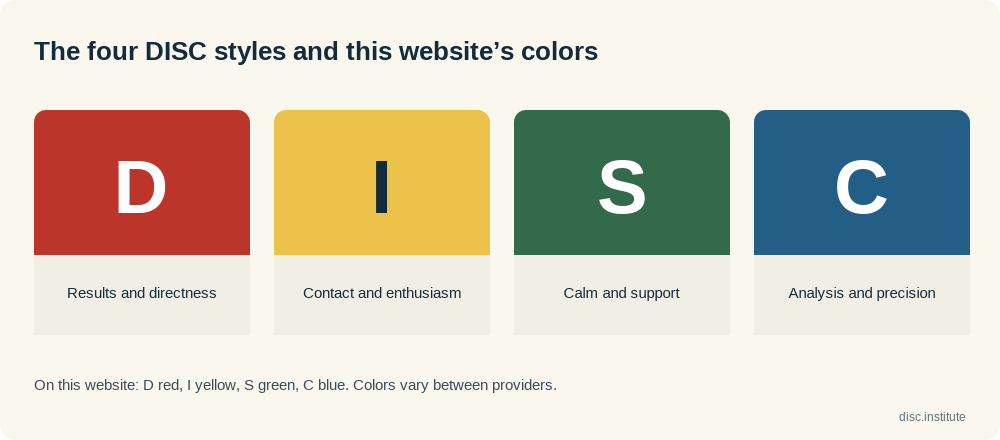
An explanatory diagram of four DISC styles. The panels show behavioral emphases, not a test result, fixed types of people or a scientifically determined color system.
How to apply this in practice
Start with the definitions behind the colours. Compare examples of pace, involvement, support and attention to detail. If you take the questionnaire, review all four relative scores and ask which descriptions fit your situation.
- 1
Identify the model behind a colour chart.
- 2
Read the four definitions together.
- 3
Use a concrete situation to examine your preferences.
Hypothetical example: an enthusiastic colleague enjoys proposing ideas but also insists on checking the budget. Calling the person only yellow would miss part of the behaviour.
Limits and responsible use
Colour alone does not identify a validated instrument. DISC and Insights Discovery are separate frameworks, and neither a colour nor a short conversation establishes ability or a complete identity.
Questions about personality colour test
How do I find my colour?
You can use this free questionnaire as a reflection exercise. Treat its result as a provisional pattern, not a definitive classification.
Are all four-colour tests DISC?
No. Check the instrument name, definitions, scoring and research instead of assuming that similar graphics mean equivalent results.
Sources and further verification
Primary or authoritative sources are included where historical, methodological, brand or privacy claims need verification.
Put the explanation into practice
Free training
Learn DISC through six free online lessons, examples and knowledge checks. Practise reading scores and applying ideas to choices and relationships.
Start free →02Study & careers
Compare two study or career options using interests, skills, requirements and practical experience. Create a free personal research plan.
Start free → WhatsApp
 Facebook
 LinkedIn
 X
 Threads
 Telegram
 Reddit
 Pinterest
 Bluesky